Thursday, October 12, 2017

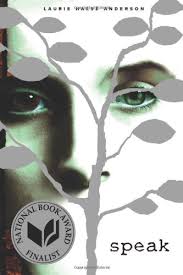
LSSL 5385 Book Blog- Speak


Anderson, L. H. (1999). Speak. Farrar, straus & giroux.

The beginning of freshman year for Melinda Sordino did not start out as a journey of new beginnings. For her, it was a journey into dark emptiness and depression. After suffering a traumatic rape that she keeps to herself and an event that leads to her being alienated by her peers over a misunderstanding, Melinda becomes non-communicative and completely isolated.

As Melinda struggles to come to terms with what happened to her, and attempting to help a friend who could become the next victim, she begins to find a voice through her gardening and an art project at school. Little does she know, eventually she’ll be confronted again by her offender, and will get the chance to face her fears and be a savior to other girls. Deciding to no longer be a victim, she stands up for herself and is vindicated.

It is a story of trauma, and an uncomfortable coming of age, but also a story of redemption and empowerment. With the mature content, I think this book is more suited for the upper level of the YA range. I think high school students could relate to this character and book vs. a younger reader on the spectrum. The issues presented in this book are easily real issues teens may face either personally or through friends.

This book allows the reader to watch how such a trauma could play out through someone else’s eyes or it could allow someone to find their own voice that has experienced a similar situation. While I ultimately think high school is more appropriate, I would be naïve to think that an older middle school reader might also relate. I can’t help but think of a former seventh grade student I had eight years ago. She had confided in me that she had been raped at a party by a classmate. As much as we wish these events were just fictional, they can happen to people of all ages. The courage to speak out and/or ask for help is a valuable message for readers of all ages. 


**Required YA novel


                                                               (Book Trailer)


http://madwomanintheforest.com/  (Author’s Webpage)


Other books by Laurie Halse Anderson:

Twisted. ISBN 9780670061013
Wintergirls. ISBN 9780670011100

LSSL 5385 Book Blog- When You Reach Me


Stead, R. (2009). When you reach me. Wendy Lamb Books.

Miranda is twelve years old and lives in New York, during the late seventies. She lives with her mother, and while they do not have a lot, she has her best friend Sal, and gets by. Everything is normal until a new kid, Marcus punches Sal while they are walking home from school.

After the punch, Sal becomes distant and stops talking to her. Miranda starts making new friends and meets Anne Marie, who just lost a friend too. One day she decides to confront the boy named Marcus, and finds that they have a lot in common, like their interest in time travel.

Miranda also begins to receive mysterious notes from a stranger who somehow seems to know the future and appears to be leaving a warning, with instructions for her. As things progress and come to a head, the people and circumstances become intertwined into a powerful crescendo that could mean life or death for someone close to her.

When you reach me is a book of many things. It is a book of coming of age, of Science Fiction, fantasy, and also a sort of period piece. This book easily fits into the Science Fiction genre with the inclusion of time travel, along with some fantasy elements. The author, Stead, cleverly builds suspense in mystery by showing small snippets of the future as it plays out in the story.

I can also see how this book fits into YA Lit because it tells the story from Miranda’s eyes. This allowed me to feel connected with Miranda, which is the point of YA lit. The subject matter of friendship and how quickly things can change, reflects common issues that are appropriate for this age range. I would recommend this book to middle grades because I think they will relate to the theme of friendship in this book. Since A Wrinkle in Time plays a big role in this book, I think it would be a great text-to-text connection if it was read too.

**Required YA author


http://www.rebeccasteadbooks.com/  (author’s webpage)

                                                         
                                                                  (Book Trailer)


Wednesday, October 4, 2017

LSSL 5385- Chapter 15 Textbook Reflection and Summary

With this list of questions, Peck offers us a tool to use when guiding students. These questions will help the students understand the text in a more critical way. They can be used for a discussion group or as a reflection. Rather than just identifying the usual elements found in text, I think these guiding questions will allow the reader to interact more with the text. This would be a great resource to include in student's reading response journal to use regularly.

As librarians/educators, it is our job to increase literacy and foster a love of reading. I think the way to achieve this is not only encouraging reading for pleasure, but also teaching students how to navigate through text, no matter what the genre. Creating critical thinking questions such as these for all genres would be beneficial. I have always considered that my job was to not only prepare my students for the right now, but for the future. Helping them understand text connections and complex thinking while reading, will be beneficial throughout their education and beyond.

It would also be a great extension activity to have students create their own questions that they can use when evaluating and comprehending text.

LSSL 5385- Chapter 11 Textbook Reflections and Summary

Realistic fiction is one of the most popular genres in our library, and I feel like it’s the most easily understood. Both contemporary and modern realistic fiction are stories that could happen in real life.  The settings and plot elements could all occur in today’s world and do not include unrealistic elements. Because the text is so real, students seem to make connections easier and see themselves in the characters. These books incorporate universal themes that gradually reveal themselves throughout the text. 

One thing that might be confusing for students is the name of the sub-genre itself. When I teach this genre, we discuss the word realistic vs. fiction and take note that they almost contradict each other. The word “real” in realistic is what throws them for a loop. After we read through some picture books together, they catch on quickly. We say fiction is fake stories. So, putting it together, we call it realistic fake stories.

It’s a believable, realistic story that the author made up. The characters is this sub-genre are also realistic, meaning they don't have magical powers. With students, I use non-examples when discussing characters and plot elements within this category. For example, we discuss well known characters from a variety of genres and identify what make them believable or unbelievable characters. We do the same thing for plot elements.

When evaluating fiction, consider whether the characters are relatable. Could the events happen in real life? Are the events consistent with the real world? The theme should slowly reveal itself through the text, rather than a more abrupt one as seen in some fables. Finally, how does the theme relate to modern readers?

While realistic fiction is the most popular when reading for pleasure, it also allows for a lot of text-to-self connections. One of the most touching books I have read was, Patricia Palocco’s Junkyard Wonders. Every time I read it, it make me tear up. It is about a little girl that struggles with reading throughout school and finds herself in a class that is different from the other kids. In the story, we see her experiences as kids tease her and the emotions she goes through as she struggles to find herself. All of the events are realistic and a lot of readers could probably relate to her struggles.

LSSL 5385- Chapter 14 Textbook Reflections and Sumamry

Graphic novels have really gained significant popularity, with students and teachers. They present information in a new format that appeals to readers of all ages. This format incorporates comic-like drawings, thought-bubbles, panels, and dialogue. Graphic novels are seen in both fiction and non-fiction, so it is important to remember that is a format, rather than a genre. One thing to note is that the text might be more complex when compared to a more traditional format.

 Fictional graphic novels tell entire stories, while nonfiction conveys information through the text.  Just as with any text, students may need support when learning how to read graphic novel. The text bubbles might be confusing initially if they don’t understand how to read from box to box. They have illustrations which are attention grabbing, but can also include complex text. I saw this when reading Persepolis. I dare anyone to say that book cannot stand up to any traditionally formatted book! It had vivid imagery and amazing details that helped carry the reader right along the main character throughout the story.

Graphic novels can be used in the classroom to support literacy, just as any other text can be used. I do know that some teachers have discounted their value, considering them to be just comics. I challenge even that being an issue because I feel like the purpose is to read, no matter what it is. In addition, why limit the student’s access to high interest text. As educators, we want to encourage a love of reading. We need to take our own personal biases out of the equation. Graphic novels can have just as big an impact as any other type of text. I personally enjoy mixing up my reading. I view it as cleansing my pallet in literary form.

In our library, we have a limited selection of graphic novels, which I hope to remedy as the new librarian. We have Lunch Lady, Babymouse, and Roller Girl. I would love to find out more information in order to build a stronger collection. I heard Max Axiom is a great book and incorporates science. Through the slide share, I was surprised to find out that 67% of teachers don’t read graphic novels. Thinking about the teachers that don’t value the GN’s as a library book choice, it made sense. They haven’t given the books a chance, so they don’t know what great things lie within the pages.

I was surprised to see how many elements were included in the descriptions. I never realized that the thought bubbles and dialogue bubbles were different. It makes sense to me why they would be, now that I think about it. I think those pages in the slide share would be a great tool to use when teaching students how to read graphic novels.

Tuesday, October 3, 2017

LSSL 5385 Ch 13 Textbook Summary and Reflection


Science fiction is futuristic fiction usually incorporating technology, space, and time travel. Science fiction does include some realistic elements, but they also incorporate fantasy. This is why science-fiction is a sub-genre of fantasy. Fantasy is set in a fictional universe and includes magical elements that are not possible in reality. Fantasy includes talking animals, and other magical elements like personification.

There are a lot of sub-genres of fantasy. Some include, apocalyptic/post apocalyptic, steam punk, dystopia, parallel universe, and many more. Both genres incorporate universal truths/themes in their text. In these genres, characters still behave in ways that are believable to the reader no matter what the situations presented in the text.

Post apocalyptic is one of my favorite sub-genres, whether it's books or movies. The book One Second After held me prisoner for two days. As noted in this chapter, what hooked me was the fact that everything that happened seemed possible. I could envision myself experiencing everything the character was going through.

This is one of the most popular genres amongst the boys at our school. I find that they will read a lot of the same ones over and over again, and it really seems to ignite their imagination. I personally don't gravitate toward science fiction, but I do love the broader range of fantasy. A really cute book called, Milk Goes to School is a great example of fantasy. In the story, it is Milk's first day of school. In some prior reading, I learned that personification helps students experience events more easily by using these fun characters.

As an elementary librarian, I think it is important to be familiar with all genres in order to be able to guide students to books. This is an area that I will look into further. It was helpful to hear so many titles along with their sub-genres in the video. The miscellaneous category intrigued me. I am drawn to books that don't fit into just one category. I think these types of books will be a good pick for kids that don't have a specific type in mind. This will be helpful when recommending books and choosing some new books for myself to read. Starters is next on my list!


LSSL 5385- Chapter 12 Summary and Reflection

Non-fiction is a very popular genre and covers many topics and types of books. We evaluate nonfiction differently than other genres. Non-fiction includes biographies, autobiographies, expository text, narratives, memoirs, and others. The credibility of the author is very important.  Since non-fiction contains informational text, it is key to evaluate the author's research for quality of information. Reviewing the bibliographic information and the acknowledgements will help you to evaluate the author's content. When questioning students about nonfiction text, it will look different than questions about fiction. Are their visuals to support their understanding?  What is the purpose of the book and for their reading? Fiction includes characters, a plot, and a resolution to a problem. In order to support student understanding, as educators, we need to make sure that students understand the text in a deeper way.

One of my favorite books is What if I Had Animal Teeth! I love that these books provide a mixture of non-fiction and fiction text. I always use this series when discussing the differences between the two genres. These dual formats are becoming more popular every year. Non-fiction itself is always an easy choice for most kids. I have noticed that they get caught up with the pictures and don't evaluate the text as much as they do with the fiction. This is where the questioning helps ensure that the students can truly understand what they are reading.

Checking if the information is factually accurate it also important. You can fact check by cross referencing information found in the books. It should also reflect a balanced view. I feel like these days, it is important to consider the author's purpose when writing the book. Bias can affect the credibility of the text. I think that is an extremely important skill to teach when evaluating resources.

It is also important to note that the book should be user friendly. To assess this, look at the text features that are available. A glossary, index, and table contents will help the students navigate through the text. Text features are always a huge lesson in fourth grade. We look through each one and discuss how they help the reader. When the students read non-fiction, I have them identify text features to facilitate their learning. Pictures, illustrations, and graphics add a lot to students' understanding. They add a visual component that helps the reader see the content. It is important to evaluate these for relevance and quality. Are they student friendly? All of these features can either add to the students' learning or take away from it.

Just like when you are considering your library selection, purpose is important. Do the books support your curriculum? Are you needing an overview or are you looking more topic specific? All of these questions will be the same ones you use to guide students through their research. Kids really do struggle with research. A lot of time is needed to teach them how to effectively conduct research. Evaluating the sources and their purpose will ensure better results for the student.

In our library, I have noticed more kids looking for non-fiction than fiction. On that note, it can be a struggle to help guide students to the right book. This genre allows readers to see things they might not normally have the opportunity to see. Using the guiding questions will allow you to develop a purposeful collection that will benefit all readers. The guiding questions in the textbook will help you to match the students to the right book.